Construction projects generate thousands of tons of excavated materials every year. Whether produced by diaphragm walls, bored piles, tunneling or other ground engineering activities, wet spoil can quickly become a major operational challenge. From loading and transportation to disposal and site safety, effective spoil management has become essential for maintaining productivity on today’s construction sites.
Wet spoil creates more than just a handling problem
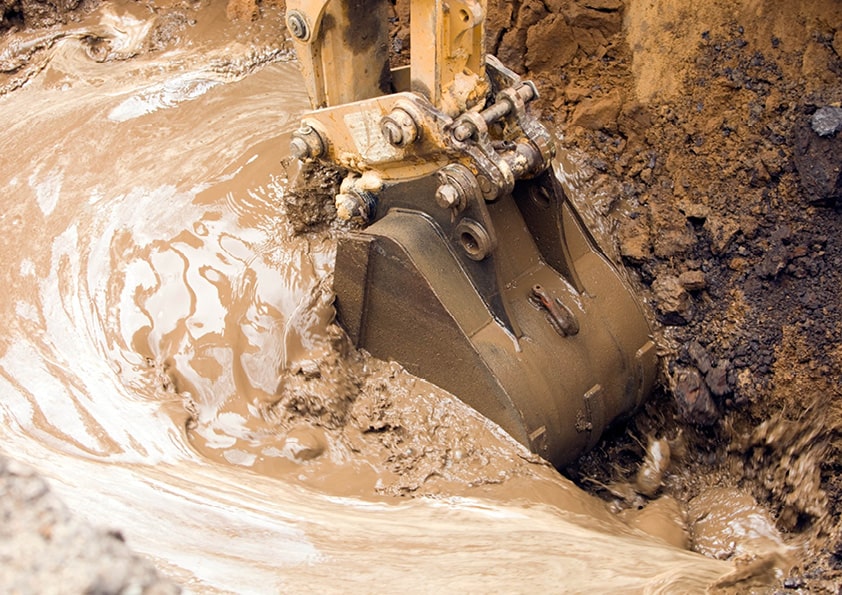
On many civil engineering and special foundation projects, excavated materials contain a significant amount of free water.
While this may initially appear to be a simple handling issue, excessive moisture often affects several stages of the construction process. Wet spoil is more difficult to load, transportation becomes less efficient, logistics become more complex and disposal requirements continue to tighten.
As projects become larger and schedules become more demanding, contractors need practical solutions that keep operations moving without disrupting production.
Productivity starts with efficient spoil management
Maintaining productivity on a construction site depends on much more than equipment and manpower.
Efficient spoil management helps contractors maintain production schedules, optimize truck loading, improve material handling and simplify transportation.
Rather than reacting once wet materials become a problem, many contractors now integrate spoil conditioning directly into their excavation process to keep projects running efficiently from the start.
Comparing spoil treatment technologies
Several technologies are currently available for treating wet excavated materials.
Mechanical dewatering systems such as filter presses, centrifuges and geotextile tubes can achieve high levels of water removal. However, these systems generally require large installation areas, continuous power supply and significant capital or rental costs. They are typically better suited to centralized or long-term operations.
Chemical stabilization methods rely on additives mixed directly into the spoil. Traditional lime and cement-based binders remain widely used but can modify the characteristics of the excavated material.
An increasingly popular alternative is the use of super absorbent polymers (SAPs), which rapidly capture free water without requiring heavy equipment or additional infrastructure.
APROMUD®: a super drying agent designed for field operations
Developed by APROTEK, APROMUD® is a super drying agent specifically engineered for construction sites where speed, flexibility and productivity are critical.
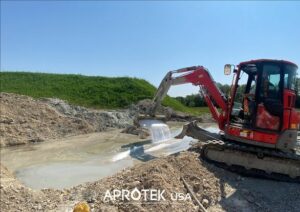
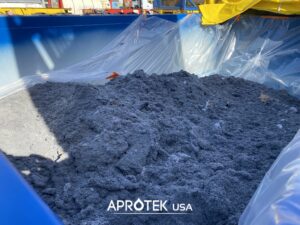
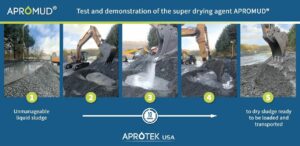
Applied directly to wet spoil, APROMUD® quickly absorbs free water, transforming highly saturated materials into stable, workable spoil that is easier to handle, load and transport.
The product integrates directly into normal excavation activities without interrupting production or requiring dedicated treatment equipment.

Fast application, low dosage and safer operations
Construction professionals require solutions that deliver measurable operational benefits while remaining easy to implement.
APROMUD® has been developed with these priorities in mind.
- Rapid action, typically within 15 minutes
- Low application rate, generally below 1% of treated material
- Non-hazardous handling for operators
- Improved material handling and transportation
- Better jobsite productivity
- Reduced logistical constraints
These advantages allow contractors to maintain production while improving both operational efficiency and jobsite safety.
Supporting more sustainable construction practices
Sustainability has become a key consideration across the construction industry.
APROMUD® is manufactured from 100% recycled raw materials, supporting circular economy initiatives while helping contractors reduce the environmental impact of spoil management.
When used on mineral spoil, the product remains chemically inert, preserving the original disposal pathway of the excavated material without altering its classification.
Its environmental performance has also been recognized through the Solar Impulse Efficient Solution label, awarded to innovative technologies that combine economic value with measurable environmental benefits.

Helping contractors keep projects moving
Every construction project presents unique challenges, but efficient spoil management remains a common objective.
By combining rapid sludge dewatering, simplified logistics and sustainable material treatment, APROMUD® helps contractors improve productivity while supporting safer, cleaner and more efficient construction operations.
At APROTEK, we believe that successful spoil management is not only about treating wet materials—it is about helping construction professionals keep their projects moving forward.